

Wholesale accounts are often framed as a retailer's tool, a way for small shops to access better pricing and fill their shelves. But that framing misses half the story. Understanding how wholesale accounts benefit carriers reveals a set of operational, commercial, and strategic advantages that go far beyond margin on a single product sale. Whether you run a regional wireless carrier or manage a retail chain selling mobile accessories, wholesale relationships shape your cost structure, your partner network, and your long-term competitive position in ways most operators underestimate.
Table of Contents
- Key takeaways
- How wholesale accounts benefit carriers operationally
- Commercial advantages of wholesale pricing and margin control
- Strategic benefits: market reach and partnership leverage
- Challenges and risks carriers should manage
- My take on what carriers consistently get wrong
- How Usacellinc supports carrier wholesale programs
- FAQ
Key takeaways
| Point | Details |
|---|---|
| Operational consolidation | Wholesale platforms reduce billing queries and manual tariff admin, freeing carrier teams for higher-value work. |
| Pricing control at scale | Partners buy at a set price and control onward pricing, protecting margins across flexible contract terms. |
| Tiered commission upside | Higher-tier wholesale partnerships deliver 5–15% commission rate bumps plus dedicated support resources. |
| Strategic market reach | Wholesale channels put products in more locations without the cost of direct carrier sales expansion. |
| Risk management matters | Returns, defect rates, and billing integration failures can quietly erode margins if left unmonitored. |
How wholesale accounts benefit carriers operationally
The operational case for wholesale accounts is strong, and it starts with what carriers spend the most time on: billing, provisioning, and partner support. When those functions are fragmented across multiple systems and manual processes, overhead climbs fast. Wholesale platforms consolidate these back-office workflows into a single environment, and the impact is measurable.
Wholesale mobile programs reduce operational overhead by consolidating billing and customer management into a single platform, meaning carriers and their partners spend significantly less time on billing queries and manual tariff administration. That is not a minor convenience. For a carrier managing dozens of reseller relationships, every billing dispute resolved automatically is one fewer support ticket, one fewer hour of staff time, and one fewer friction point in the partner relationship.
Telecom wholesale billing is specifically designed for high-volume, low-margin transactions. Rather than itemizing every end-user line, automated billing systems match millions of usage records to pricing agreements at scale, improving accuracy and building partner trust over time. That kind of automation is not achievable with retail billing infrastructure.
Here is what consolidation actually delivers for carriers in practice:
- Fewer inbound billing disputes from reseller partners
- Faster settlement cycles with automated reconciliation
- Reduced manual tariff administration across product lines
- Cleaner provisioning workflows tied to partner accounts
- More consistent commission tracking across tiered programs
Pro Tip: Set up automated dispute workflows before you go live with a wholesale billing platform. Fixing reconciliation gaps after launch costs three times as much in staff time and partner trust as building them in from the start.
Tiered partner programs add another layer of operational benefit. Carrier partner programs pay commissions based on tiered revenue levels and provide varying levels of support, which means the more volume a partner generates, the more aligned the support structure becomes. That alignment reduces the operational burden on carrier teams because high-performing partners need less hand-holding and generate fewer escalations.
Commercial advantages of wholesale pricing and margin control
The commercial model behind wholesale accounts gives carriers a degree of pricing flexibility that direct sales simply cannot replicate. The core mechanic is straightforward: partners buy at price X and resell at price Y, with full control over their onward pricing and customer relationships. Carriers set the floor. Partners own the ceiling. That separation protects the carrier's wholesale margin while giving resellers the autonomy they need to compete in their local markets.

This model works across both short-term and long-term contract structures, which matters for carriers managing diverse partner portfolios. A retail partner running month-to-month agreements needs different commercial terms than a regional distributor on a 24-month contract. Wholesale account structures accommodate both without requiring carriers to rebuild their pricing logic from scratch.
The commission tier structure deserves more attention than it usually gets. Here is how the commercial incentives typically stack up:
- Entry-tier partners receive base commission rates and standard support, enough to get started but not optimized for volume.
- Mid-tier partners unlock rate improvements and gain access to channel manager support, reducing the carrier's direct involvement in day-to-day account management.
- Gold-tier partners receive dedicated sales engineering and co-selling opportunities, which directly improve close rates on larger deals without increasing carrier headcount.
- Volume bonuses at higher tiers can represent 5 to 15 percentage point improvements in effective commission rates, creating a self-reinforcing incentive for partners to grow.
- Deal registration protects commissions on specific opportunities, reducing channel conflict and giving carriers cleaner visibility into pipeline.
Pro Tip: Do not evaluate a wholesale partnership purely on headline commission rates. The real commercial value often sits in MDF funds, co-selling support, and renewal treatment at higher tiers. Those benefits compound over time in ways that a 2% rate difference never will.
Margin protection through automated billing and dispute processes is another commercial advantage that carriers overlook. Automation and reconciliation in wholesale billing enable scalability and protect margins better than manual retail billing, because automated controls catch discrepancies before they become write-offs. That is a direct contribution to carrier profitability that shows up in the P&L even when it is invisible in day-to-day operations.
Strategic benefits: market reach and partnership leverage
Wholesale accounts are one of the most cost-effective tools carriers have for expanding market reach without expanding headcount. When you sell through wholesale partners, you are essentially multiplying your distribution footprint using someone else's retail infrastructure. Selling wholesale puts products in more retail locations, improves inventory turnover, and optimizes storage space, all without the carrier absorbing the full cost of direct retail expansion.
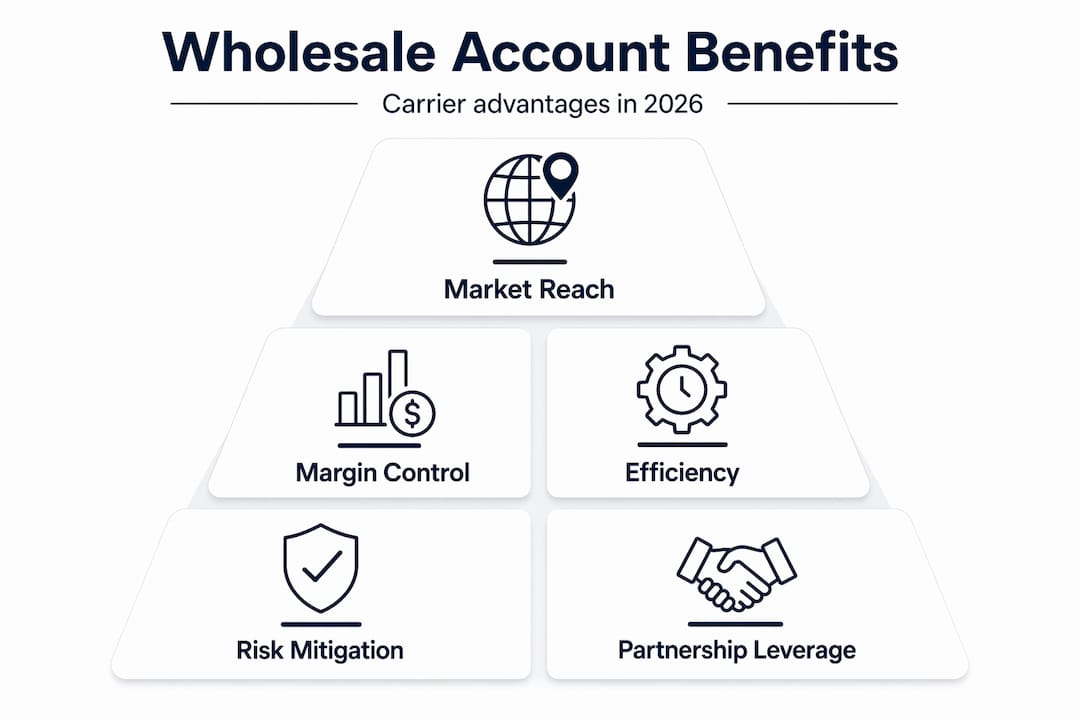
Compare what that looks like in practice:
| Growth approach | Carrier cost | Speed to market | Partner dependency |
|---|---|---|---|
| Direct retail expansion | High (real estate, staff, inventory) | Slow (6 to 18 months per location) | Low |
| Wholesale partner network | Low (platform and support costs) | Fast (partner-led onboarding) | Medium |
| Hybrid model | Medium | Medium | Low to medium |
The wholesale channel also reduces the complexity of direct sales. Carriers working through technology service distributors and wholesale partners offload a significant portion of customer acquisition cost to the partner. The partner owns the customer relationship at the retail level. The carrier owns the product and the pricing floor. That division of labor is efficient when managed well.
Strategic advantages of wholesale partnerships for carriers include:
- Access to customer segments the carrier cannot reach cost-effectively through direct channels
- Faster cash flow from volume orders compared to individual retail transactions
- Reduced marketing spend per unit because partners drive local demand
- Better inventory forecasting through partner purchase data and demand signals
- Relationship capital that compounds over time as partner trust increases
Reducing fragmentation through a consolidated wholesale platform lets partners focus on customer retention instead of billing issues, and that focus translates directly into lower churn for the carrier's underlying product. A partner who is not fighting billing errors is a partner who is selling more.
Challenges and risks carriers should manage
Wholesale accounts carry real operational risks, and carriers who ignore them tend to discover them at the worst possible time. The most common failure mode is underestimating the integration work required to connect wholesale billing with existing finance systems.
Wholesale billing at scale requires tight integration with finance to prevent operational overhead increases after go-live. Carriers who treat billing integration as a post-launch task often find themselves managing manual reconciliation at volume, which eliminates the efficiency gains that made the wholesale model attractive in the first place.
In the mobile accessories segment specifically, returns and defect rates are a persistent margin threat. High-margin SKUs can become less profitable if they generate significant refunds and support tickets. A case that sells well but returns frequently is not a good product. It is a liability dressed up as revenue.
Key risks to monitor in your wholesale accessory program:
- Return merchandise authorization (RMA) volume as a percentage of units sold
- Defect rates by SKU and supplier, tracked separately from overall return rates
- Support ticket volume tied to specific product lines
- Inventory obsolescence risk on accessories tied to device models with short cycles
- Partner performance metrics beyond revenue, including attach rates and customer satisfaction
Pro Tip: Track your true cost per SKU by adding RMA processing costs, support tickets, and restocking fees to your cost of goods. Gross margin alone will mislead you. The SKUs that look best on a spreadsheet are sometimes the ones quietly destroying your operational efficiency.
Over-reliance on commission income without monitoring operational KPIs is another common mistake. Commission revenue is real, but it is also the most visible metric in a wholesale relationship. The less visible costs, including support overhead, billing disputes, and returns processing, often grow faster than commission income when a program scales without proper controls in place.
My take on what carriers consistently get wrong
I have watched carriers enter wholesale partnerships with a clear-eyed view of the commission structure and almost no view of what happens after the contract is signed. The operational overhead question is almost always underestimated. Teams that looked lean during the sales cycle suddenly look stretched six months post-launch when billing queries are stacking up and partner escalations are hitting the wrong inboxes.
The carriers who do this well share one habit: they treat customer billing lifecycle ownership as a strategic asset, not an administrative function. When partners own their billing relationship cleanly, margin retention improves and support costs drop. When that ownership is ambiguous, everyone pays for it.
My honest view is that tiering and support quality have a bigger real-world impact than headline commission rates for most carriers. A 3% commission improvement means nothing if your gold-tier partners are getting the same support response times as entry-level accounts. The carriers who invest in differentiated support at higher tiers see better partner retention, higher volume growth, and fewer escalations. That is not a coincidence.
On the accessories side specifically, I have seen carriers get burned by ignoring defect rate data until it became a financial problem. Tracking returns and RMA costs at the SKU level from day one is not optional if you want your gross margin figures to mean anything. The true profitability picture only emerges when you account for all operational cost drivers, not just the purchase price and the sell price.
— v
How Usacellinc supports carrier wholesale programs
If you are a wireless carrier or retailer looking to put these wholesale account advantages into practice, the product side of the equation matters as much as the commercial structure. Usacellinc offers over 15,000 mobile accessories at up to 70% off MSRP, with no membership fees and no minimum order requirements. That means you can test new SKUs without committing to bulk inventory, and scale up on the products that actually move.
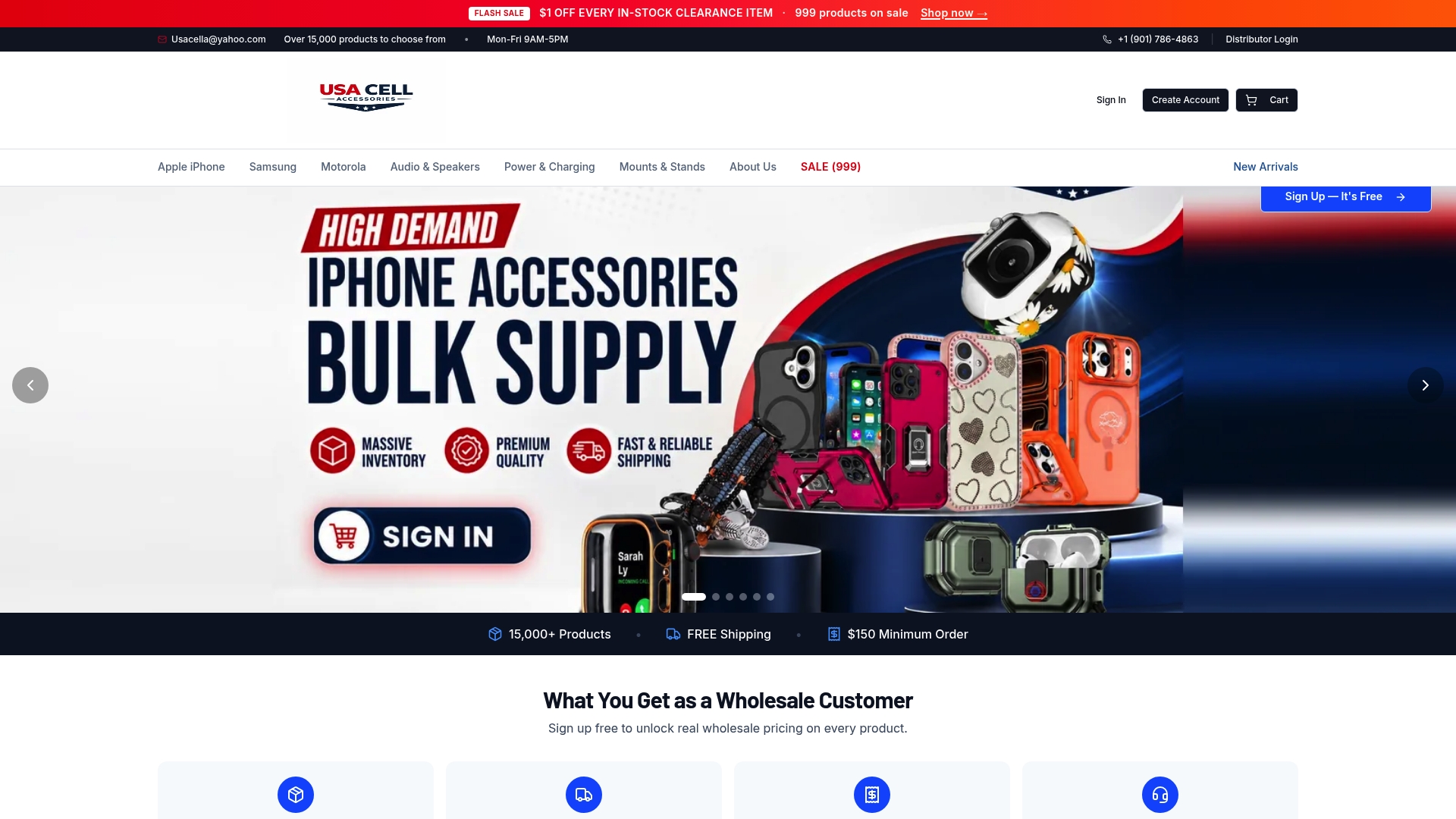
Their catalog covers the device families your customers actually use, including wholesale Samsung accessories, wholesale iPhone accessories, and wholesale Motorola accessories. Most orders ship the same day, which matters when your retail partners need stock quickly and cannot wait on slow fulfillment cycles. For carriers building out their accessory programs or retailers looking to tighten their cost structure, Usacellinc's wholesale catalog is worth exploring as a direct sourcing option that works with your existing wholesale account model.
FAQ
How do wholesale accounts reduce operational costs for carriers?
Wholesale platforms consolidate billing, provisioning, and partner management into a single system, cutting down on manual tariff administration and billing disputes. Automated reconciliation at scale protects margins better than manual retail billing processes.
What commission benefits do carriers get from tiered wholesale programs?
Tiered carrier programs offer commission rate improvements of 5 to 15 percentage points at higher tiers, along with dedicated channel managers, MDF funds, and co-selling opportunities that directly improve commercial outcomes.
How does wholesale pricing help carriers control their margins?
Wholesale accounts let partners buy at a fixed price and set their own onward pricing, giving carriers a protected margin floor while partners retain flexibility to compete at the retail level on their own terms.
What risks should carriers watch for in wholesale accessory programs?
Returns, defect rates, and RMA processing costs are the most common margin threats in mobile accessories wholesale. Gross margin figures alone do not capture these costs, so tracking true per-SKU profitability is critical.
How do wholesale partnerships help carriers expand market reach?
Wholesale channels put carrier products into more retail locations through partner networks without requiring direct investment in real estate or additional sales staff, reducing customer acquisition costs while improving inventory turnover.